
ConfigGroupsEditor
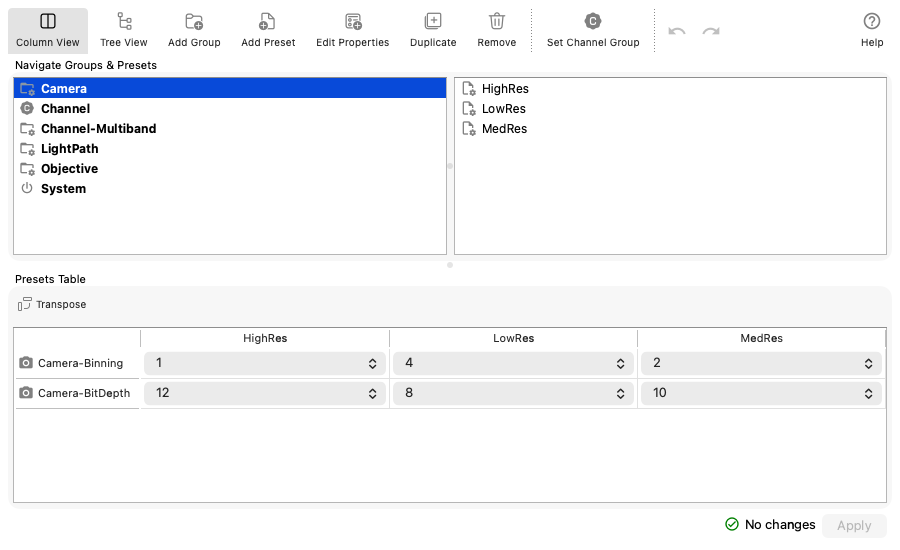
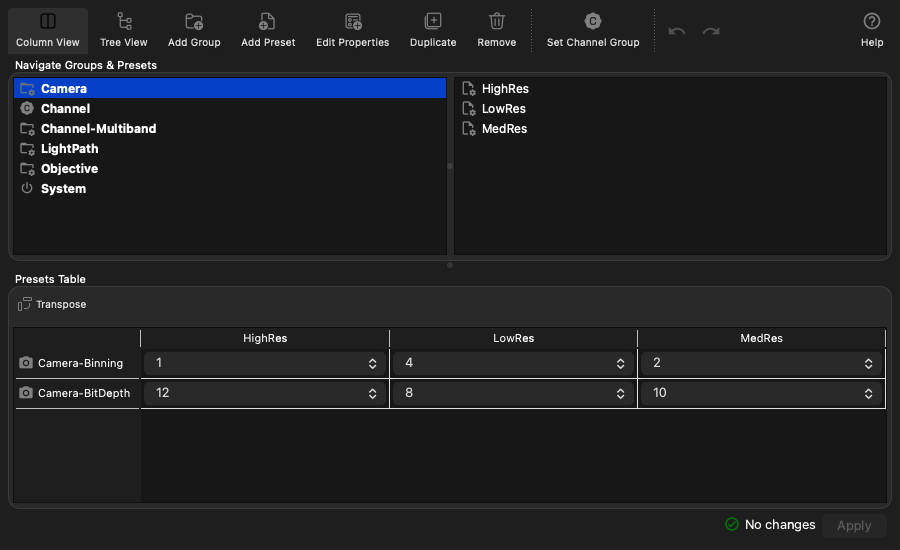
Example
API
Bases: QWidget
Editor for configuration groups and their presets.
The editor doesn't change the core. Build it from a core with
create_from_core, and
connect to applyRequested to apply the user's changes.
Emitted (with no arguments) whenever the user edits a group or preset.
Emitted when the user clicks "Apply".
Arguments are (changed, deleted, channel_group): the new or changed
ConfigGroups, the names of deleted groups, and the name of the group that
should become the channel group (or None if that didn't change).
classmethod

create_from_core(
    core: CMMCorePlus,
    parent: QWidget | None = None,
    *,
    load_configs: bool = True,
) -> ConfigGroupsEditor
Create a ConfigGroupsEditor from a CMMCorePlus instance.
Available devices are loaded from the core, and if load_configs is True,
config groups/presets are also loaded.
update_from_core(
    core: CMMCorePlus,
    *,
    update_devices: bool = True,
    update_configs: bool = False,
) -> None
Refresh the editor from the current state of the core.
Parameters:
| Name | Type | Description | Default |
|---|---|---|---|
core
|
CMMCorePlus
|
The core instance to pull data from. |
required |
update_devices
|
bool
|
If True, refresh the list of loaded devices and their properties. This determines which devices and properties appear in the "Edit Properties" and "Add Property" dialogs. |
True
|
update_configs
|
bool
|
If True, replace the current editor contents with config groups, presets, and their settings from the core. If False, the current groups/presets will be left unchanged (meaning you will have an empty editor until you add groups/presets manually). |
False
|
setCurrentGroup(group: str) -> QModelIndex
Set the currently selected group in the editor.
Returns the index of the group that was selected, or an invalid index if no such group exists.
Set the currently selected preset in the editor.
Returns the index of the preset that was selected, or an invalid index if no such preset exists.
setData(data: Iterable[ConfigGroup]) -> None
Set the configuration data to be displayed in the editor.
data() -> Sequence[ConfigGroup]
Return the current configuration data as a list of ConfigGroup.
Return groups that changed, deleted names, and desired channel group.
Compares only preset content (not the is_channel_group flag).
The channel group designation is returned separately so the consumer
can call setChannelGroup without needlessly recreating groups.
Returns:
| Type | Description |
|---|---|
tuple[list[ConfigGroup], list[str], str | None]
|
(changed_or_new_groups, deleted_group_names, channel_group_name). channel_group_name is the name of the group that should be the channel group, or None if the designation did not change. |